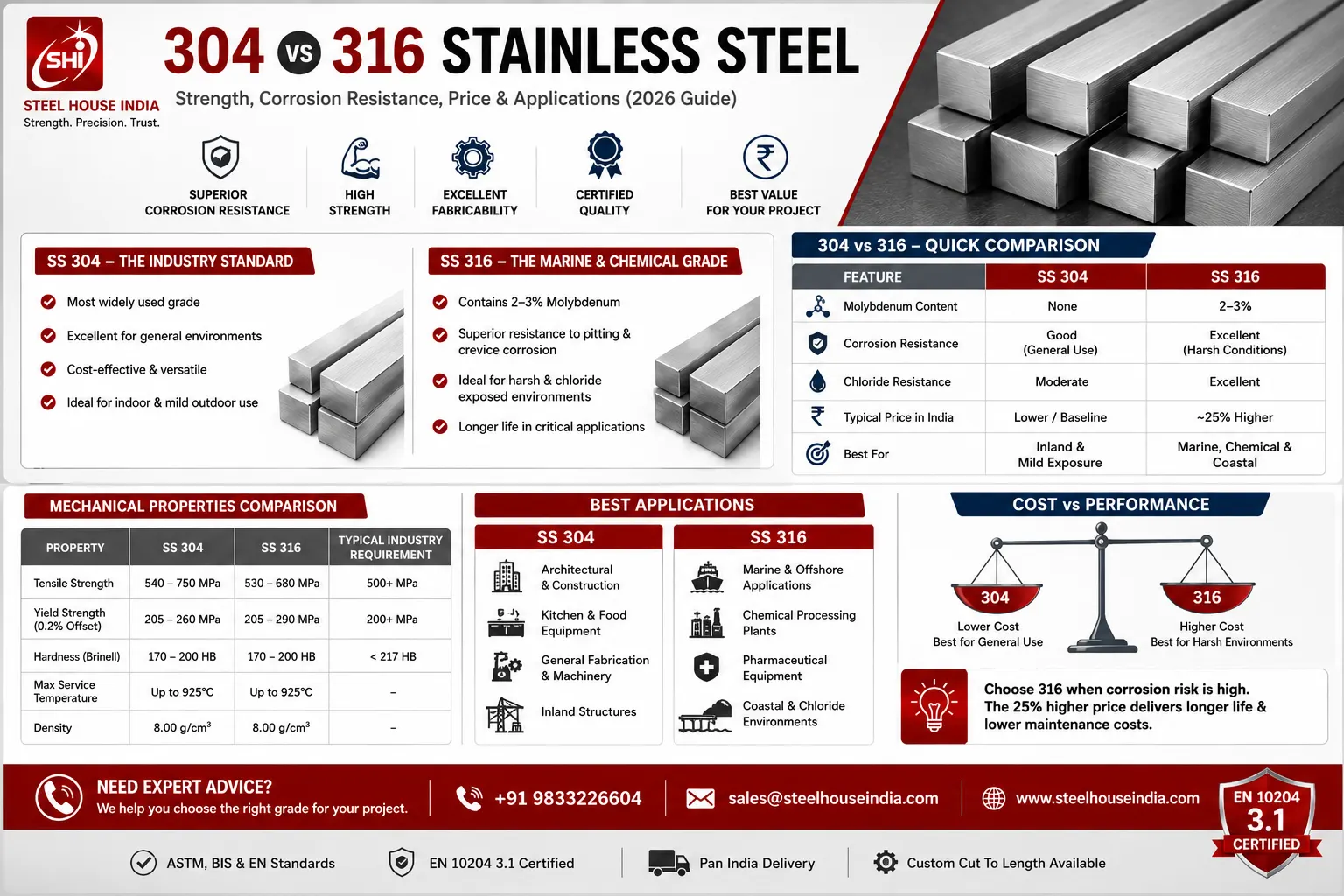
Choosing the right grade of stainless steel is one of the most critical decisions in industrial fabrication, construction, and manufacturing. For procurement managers, engineers, and fabricators, the choice between Grade 304 and Grade 316 is rarely just about availability; it is about ensuring the long-term structural integrity and cost-efficiency of a project. While both are austenitic stainless steels and may look identical to the naked eye, their chemical compositions and environmental performance differ significantly.
Understanding the Basics of SS 304 and SS 316
What is Grade 304 Stainless Steel? (The Industry Standard)
Grade 304 is the most widely used austenitic stainless steel among Indian manufacturers. It offers an excellent balance of formability, durability, and corrosion resistance in normal environments. It is the preferred choice for general-purpose applications where extreme conditions are not expected. Whether you are working on architectural framing or kitchen appliances, Grade 304 provides reliable, cost-effective performance.
Explore our SS 304 Square Bars inventory | Explore our SS 316 Square Bars inventory
What is Grade 316 Stainless Steel? (The Marine & Chemical Grade)
Grade 316 is a premium austenitic stainless steel containing 2–3% molybdenum. This specific alloy addition provides significantly better resistance to pitting and crevice corrosion, making it the industry standard for harsh industrial and marine environments. In sectors where exposure to salt-laden air or aggressive chemicals is constant, Grade 316 is not just a preference; it is a necessity for material longevity.
Why Chemical Composition Makes a Big Difference
The key differentiator between these two alloys is molybdenum. While both grades form a protective chromium oxide layer that prevents iron from oxidizing, Grade 316's molybdenum content creates a more robust passive film. This film protects against chlorides, acids, and saline conditions where the protective layer of Grade 304 would eventually fail. For those managing large-scale projects, understanding these chemical nuances is the difference between a project that lasts for decades and one that requires premature replacement. For complete sizes, weight charts, and current prices, see our Definitive Resource for Stainless Steel Square Bars.
Side-by-Side Technical Comparison: 304 vs 316
When evaluating materials for a specific industrial application, a technical comparison is essential for decision-making. The table below highlights the core performance differences between these two grades.
Chemical Composition & Property Comparison
| Feature | SS 304 Square Bar | SS 316 Square Bar |
|---|---|---|
| Molybdenum Content | None | 2–3% |
| Corrosion Resistance | Good (General use) | Excellent (Harsh conditions) |
| Chloride Resistance | Moderate | Excellent |
| Typical Price in India | Lower / Baseline | ~25% Higher |
| Best For | Inland & Mild Exposure | Marine, Chemical & Coastal |
Corrosion Resistance in Different Environments
Grade 304 works exceptionally well in inland and mild outdoor settings. However, in coastal areas like Mumbai and Chennai or chemical hubs in Gujarat, Grade 316 is strongly recommended to prevent premature corrosion. The chloride ions present in saltwater or chemical processing waste can quickly break down the protective surface of 304, leading to visible pitting. By contrast, Grade 316 is specifically engineered to resist this chloride-induced degradation.
Mechanical Strength, Temperature & Durability
Both grades offer excellent tensile strength and ductility. They perform well across a wide temperature range and are suitable for structural square bar applications, though neither is ideal for high-abrasion environments. According to mechanical property standards, both grades are austenitic, which provides them with excellent weldability and high-temperature performance, far outperforming standard structural steel that requires constant coating maintenance.
| Property | SS 304 Square Bar | SS 316 Square Bar | Typical Industry Requirement |
|---|---|---|---|
| Tensile Strength | 540 – 750 MPa | 530 – 680 MPa | 500+ MPa |
| Yield Strength (0.2% Offset) | 205 – 260 MPa | 205 – 290 MPa | 200+ MPa |
| Hardness (Brinell) | 170 – 200 HB | 170 – 200 HB | < 217 HB |
| Max Service Temperature | Up to 925°C | Up to 925°C | - |
| Density | 8.00 g/cm³ | 8.00 g/cm³ | - |
When to Choose 304 vs 316 Stainless Steel
Best Applications for SS 304 Square Bars
Grade 304 is the ideal candidate for food processing equipment, architectural framing, inland construction, and general fabrication where chloride exposure is minimal. Because it is highly versatile, it is often the first choice for non-critical structural components that are protected from the elements.
Best Applications for SS 316 Square Bars
Grade 316 is best suited for marine fittings, coastal structures, chemical processing plants, and pharmaceutical equipment exposed to aggressive cleaning agents. In the pharmaceutical industry, for example, the equipment must withstand heavy sterilization and acidic disinfectants, which would destroy the surface integrity of Grade 304.
Cost vs Performance Analysis – Which Grade Should You Buy?
Grade 304 is more budget-friendly and sufficient for most standard applications. However, choosing the cheaper grade for a high-corrosion environment is a false economy. Choose Grade 316 when the corrosion risk is high—the 25% higher price is usually recovered through a much longer service life and significantly lower maintenance costs.
Technical Specifications & Fabrication Guide
Tensile Strength, Yield Strength & Hardness Comparison
Both grades deliver strong mechanical performance. Grade 304 typically offers a tensile strength of 540–750 MPa, while Grade 316 ranges from 530–680 MPa—more than adequate for most industrial square bar uses. Because they are part of the austenitic family (the same family as 90% of consumed stainless steel), they offer a reliable baseline for structural engineering tasks.
Welding, Machining & Fabrication Characteristics
Both 304 and 316 are easy to weld and machine. With over 30 years of experience, we ensure our materials maintain excellent workability when proper tools and techniques are used. Fabricators should note that when using 316L (a low-carbon variant), the risk of weld decay is virtually eliminated, which is an added benefit for complex assemblies.
International Standards & Certifications
All our stainless steel square bars comply with ASTM, BIS, and EN standards. We provide EN 10204 3.1 certification with every order for complete traceability and quality assurance. This certification acts as a guarantee that the chemical composition matches the rigorous standards required for modern infrastructure.
Frequently Asked Questions (FAQ)
Can 304 and 316 stainless steel be welded together?
Yes, they can be welded using appropriate filler materials. However, always assess the risk of galvanic corrosion if the joint is placed in a highly corrosive environment.
Is 316 always better than 304?
No. Grade 316 is superior only in corrosive environments. For general use, Grade 304 is more economical and practical.
How do I identify whether my bars are 304 or 316?
Visual appearance is identical. Use Positive Material Identification (PMI) testing or rely on mill test certificates provided by the supplier.
Does 316 justify the higher price for marine or chemical projects?
Yes. In aggressive environments, Grade 316 reduces long-term maintenance and replacement costs, offering better overall value.
Which grade is better for food processing and pharmaceutical use?
Both are hygienic, but Grade 316 is preferred in pharmaceutical environments that require superior resistance to the harsh chemical disinfectants often used in sterilization.
Ready to Source the Right Grade?
Contact Steel House India today for expert guidance, competitive pricing, and fast delivery. Call +91 9833226604 or email sales@steelhouseindia.com.