When buyers compare stainless steel grades, the difference between 304 and 304L
round bars often creates confusion. On paper, both look very similar. Both are
widely used, both offer strong corrosion resistance, and both are trusted across
industries like fabrication, engineering, construction, food processing, and
chemical applications.
But in actual industrial use, that small "L" changes more than most buyers
expect.
The right choice depends on how the material will be used, whether welding is
involved, how important corrosion resistance is in the long term, and what kind
of fabrication process your project requires. Many procurement teams make the
mistake of choosing based only on price or availability, and that usually
creates problems later during production.
Before selecting between the two, many buyers first review trusted sources for
Stainless Steel 304
Round Bars Manufacturers in India to understand available sizes,
specifications, and supply consistency. This helps avoid buying based only on
grade name and focuses the decision on actual application requirements.
This guide explains the practical difference between Stainless Steel 304 Round
Bars and Stainless Steel 304L Round Bars so you can choose based on performance,
not assumptions.
Understanding Stainless Steel 304 and 304L Round Bars
Stainless Steel 304 is one of the most commonly used austenitic stainless steel
grades in the world. It is known for excellent corrosion resistance, good
strength, strong formability, and easy fabrication. It performs reliably in
general industrial environments and is often the default choice for many
applications.
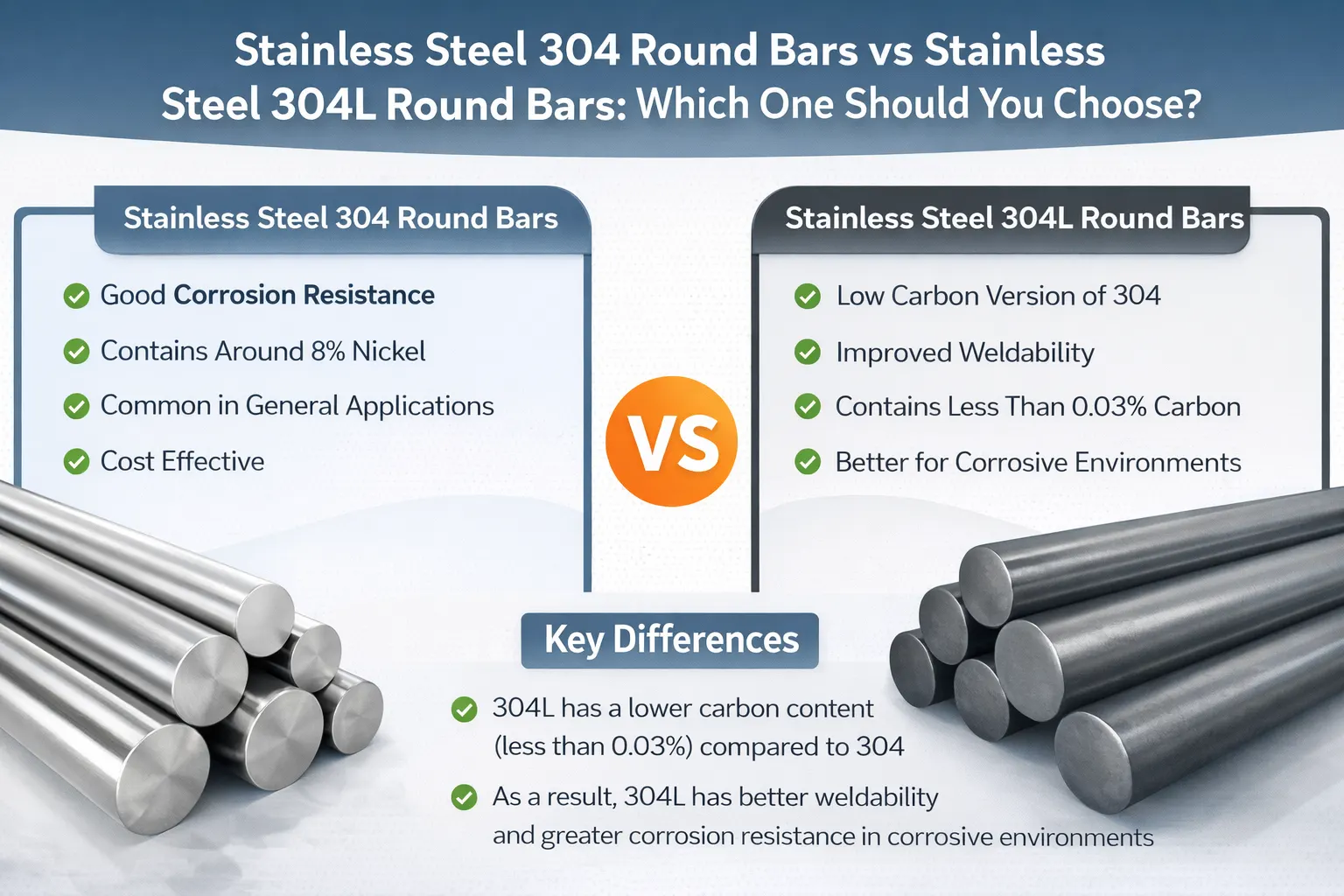
Stainless Steel 304L is a low-carbon version of 304. The "L" stands for low
carbon.
That lower carbon content is the key difference.
It improves weldability and reduces the risk of carbide precipitation during
welding, which helps maintain corrosion resistance after fabrication. This
becomes especially important in projects where heavy welding is involved or
where the final product will operate in corrosive environments for long
periods.
Both grades are strong choices. The better one depends entirely on how the
material will be used.
The Real Difference Between 304 and 304L Is Not Strength — It Is Welding Performance
Many buyers assume 304L must be stronger because it sounds like an upgraded
version of 304. In reality, the main difference is not strength. It is how the
material behaves after welding.
Standard 304 contains slightly more carbon. This helps with strength, but during
welding, that carbon can react with chromium and create carbide precipitation.
When that happens, corrosion resistance near the weld area can reduce.
304L solves that issue by lowering carbon content.
That means if your project includes significant welding, tanks, pressure
equipment, structural fabrication, or chemical processing units, 304L often
becomes the safer long-term choice.
If welding is minimal and the application is more focused on machining or
general fabrication, standard 304 is often more practical and cost-effective.
Corrosion Resistance Comparison in Real Working Conditions
Both grades offer strong corrosion resistance in normal environments. For indoor
industrial use, general engineering, fabrication, and commercial applications,
both perform well.
The difference becomes more visible in aggressive environments.
If the application involves moisture, chemicals, repeated washdowns, or welded
structures exposed to long-term corrosion risks, 304L usually performs better
because it protects the welded zones more effectively.
This is where many buyers make expensive mistakes.
The material itself may be good, but if welded sections begin corroding early,
the issue is not the grade — it is the wrong grade selection.
That is why engineers working on process plants, food-grade systems, and
chemical units often prefer 304L despite the slightly higher cost.
Which Grade Is Better for Machining and Fabrication?
For machining-focused applications, many buyers still prefer standard 304.
It offers slightly better strength and works well for shafts, fasteners,
structural components, and machined industrial parts. It is commonly used where
welding is limited and dimensional consistency matters more than weld-zone
corrosion resistance.
304L performs exceptionally well in fabrication-heavy environments where
cutting, bending, and especially welding are frequent.
This is where the decision should be practical, not theoretical.
If your workshop spends more time machining than welding, 304 often makes more
sense. If welding dominates the process, 304L usually saves more money in the
long run by reducing future corrosion issues.
Price Difference: Why Cheaper Material Can Become More Expensive
Many buyers compare only the per-kg rate and stop there.
That is where wrong decisions begin.
304 Round Bars are usually slightly more economical than 304L because of
standard composition and wider general usage. This makes them attractive for
budget-sensitive projects.
But if the application requires heavy welding and corrosion resistance after
fabrication, choosing cheaper 304 may actually increase costs through rework,
maintenance, and shorter service life.
304L may cost more upfront, but it often reduces lifecycle cost.
The better question is not "Which is cheaper?" It is "Which one creates fewer
problems after installation?"
That is the question experienced buyers ask.
Common Applications of Stainless Steel 304 Round Bars
304 Round Bars are widely used in engineering workshops, fabrication units,
architectural structures, fasteners, shafts, machine components, and industrial
support systems.
They are trusted because they balance strength, corrosion resistance, and
affordability.
For projects where welding is limited and standard industrial performance is
enough, 304 remains the preferred choice.
This is why buyers frequently work with reliable Stainless Steel 304
Round Bars Manufacturers in India to ensure consistency in dimensions,
finish, and supply timelines. Because once machining starts, consistency matters
more than marketing claims.

Common Applications of Stainless Steel 304L Round Bars
304L Round Bars are commonly used in food processing equipment, pharmaceutical
systems, chemical plants, pressure vessels, storage tanks, piping systems, and
welded fabrication structures.
Anywhere corrosion resistance after welding matters, 304L becomes more
valuable.
It is not chosen because it sounds better. It is chosen because replacing failed
welded sections later is far more expensive than choosing the right material at
the beginning.
This is why buyers sourcing for long-term industrial reliability usually compare
trusted Stainless
Steel 304L Round Bars Manufacturers in India before finalizing
procurement decisions.
The goal is not just supply. It is confidence in performance.
ASTM A276 Specification and Why It Matters for Both Grades
Whether you choose 304 or 304L, ASTM A276 matters.
It defines dimensions, tolerances, straightness, finish, and mechanical
properties for stainless steel bars. Without this standard, buying becomes
inconsistent and unpredictable.
Two suppliers may both claim to sell 304 or 304L, but ASTM compliance helps
ensure that what you receive performs as expected.
This becomes even more important when precision machining or industrial
fabrication is involved.
Midway through supplier evaluation, many buyers also refer to ASTM
A276 AISI 304 Stainless Steel Round Bars Online in India to compare
specifications, dimensions, and practical buying considerations before
finalizing orders.
That extra step often prevents major procurement mistakes.
Which One Should You Choose?
If your project involves general engineering, machining, moderate corrosion
exposure, and limited welding, Stainless Steel 304 Round Bars are often the
smarter and more economical choice.
If your project involves extensive welding, aggressive environments, chemical
exposure, or long-term corrosion concerns around weld zones, Stainless Steel
304L Round Bars are usually the better investment.
There is no universally better option.
There is only the right option for the right application.
That distinction matters far more than price.
Final Thoughts
Comparing Stainless Steel 304 and Stainless Steel 304L Round Bars should never
be treated as a simple grade comparison.
It is really a decision about fabrication method, operating environment,
maintenance expectations, and long-term performance.
Most procurement mistakes happen because buyers focus only on initial cost
instead of total operational impact.
The smartest buyers do the opposite.
They think about what happens after installation.
Because once the material enters production, changing the decision becomes
expensive.
Choosing correctly at the beginning is always cheaper than fixing the wrong
decision later.